
Full Story
The Great Blue Hole: Belize's Giant Ocean Sinkhole
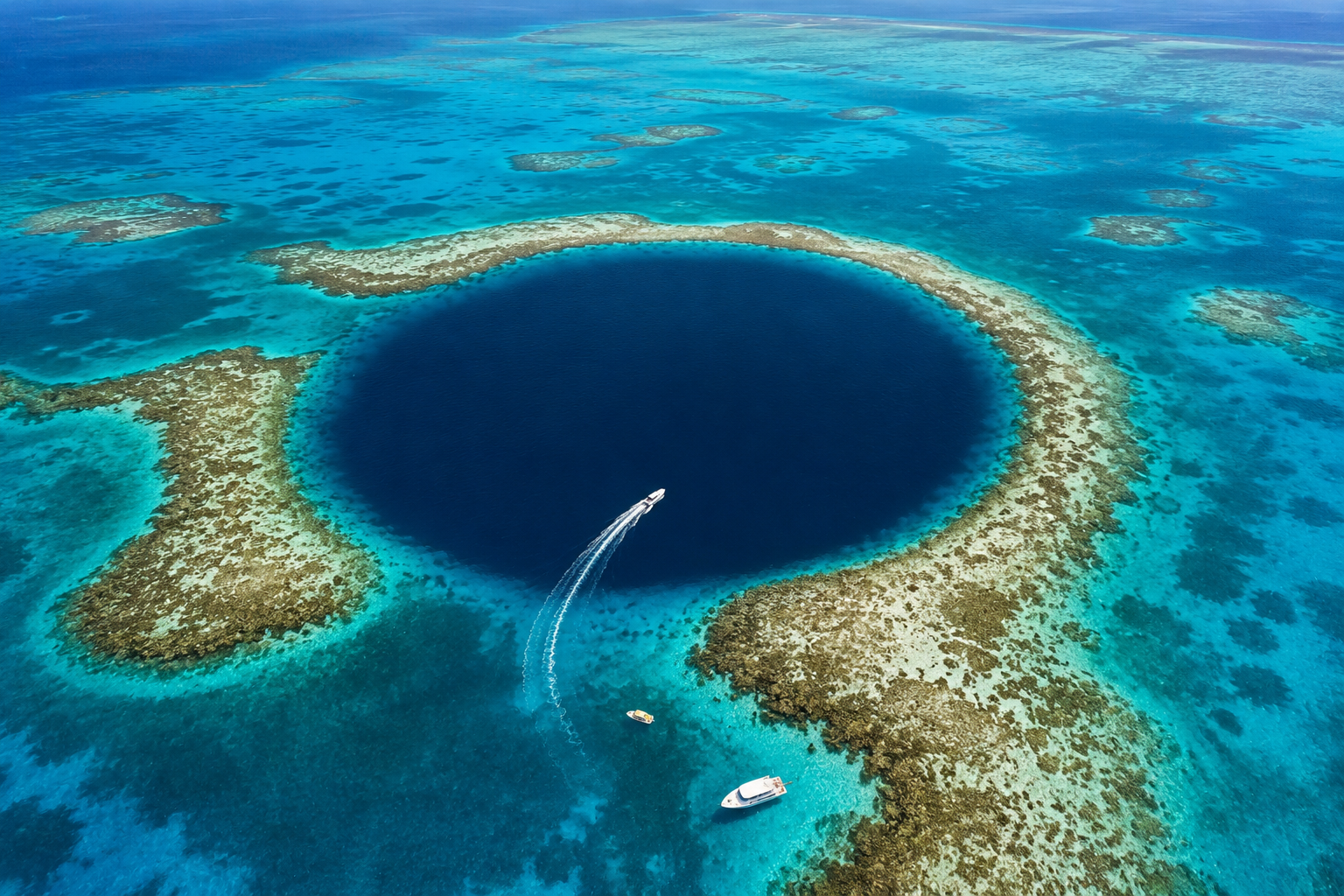
From an airplane, it looks almost unreal.
A perfectly circular patch of deep navy blue interrupts the bright turquoise waters of the Caribbean Sea.
This is the Great Blue Hole—one of Earth's most breathtaking natural wonders.
A Giant Underwater Cave
The Great Blue Hole wasn't always underwater.
During the last Ice Age, sea levels were much lower, and the area was a massive limestone cave system.
As glaciers melted and sea levels rose thousands of years ago, the cave flooded.
Eventually, its roof collapsed, leaving behind the enormous circular sinkhole we see today.
How Big Is It?
The Great Blue Hole measures approximately 318 meters (1,043 feet) across and reaches a depth of about 124 meters (407 feet).
It is one of the largest marine sinkholes ever discovered.
From space, its nearly perfect circular shape is clearly visible against the surrounding coral reefs.
A Diver's Paradise
The Blue Hole attracts divers from around the world.
Deep inside are giant stalactites that formed when the cave was still above sea level.
Divers also encounter reef sharks, nurse sharks, Caribbean reef sharks, and countless tropical fish.
Jacques Cousteau Helped Make It Famous
In 1971, legendary ocean explorer Jacques Cousteau explored the Great Blue Hole aboard the research vessel *Calypso*.
He declared it one of the world's best diving locations, bringing international attention to this incredible site.
Part of a UNESCO World Heritage Site
The Great Blue Hole lies within the Belize Barrier Reef Reserve System, which became a UNESCO World Heritage Site in 1996.
The surrounding reef is home to hundreds of marine species and plays an important role in protecting Belize's coastline.
One of Nature's Greatest Mysteries
Even after decades of exploration, scientists continue studying the Blue Hole to better understand its geology, climate history, and underwater ecosystems.
Its stunning appearance and fascinating origin make it one of the most unbelievable places on Earth.
Sometimes, nature creates wonders that look too perfect to be real.