
Full Story
The Human Library: Where You Borrow a Person Instead of a Book
Imagine entering a library and choosing a person instead of a book.
That is the idea behind the Human Library.
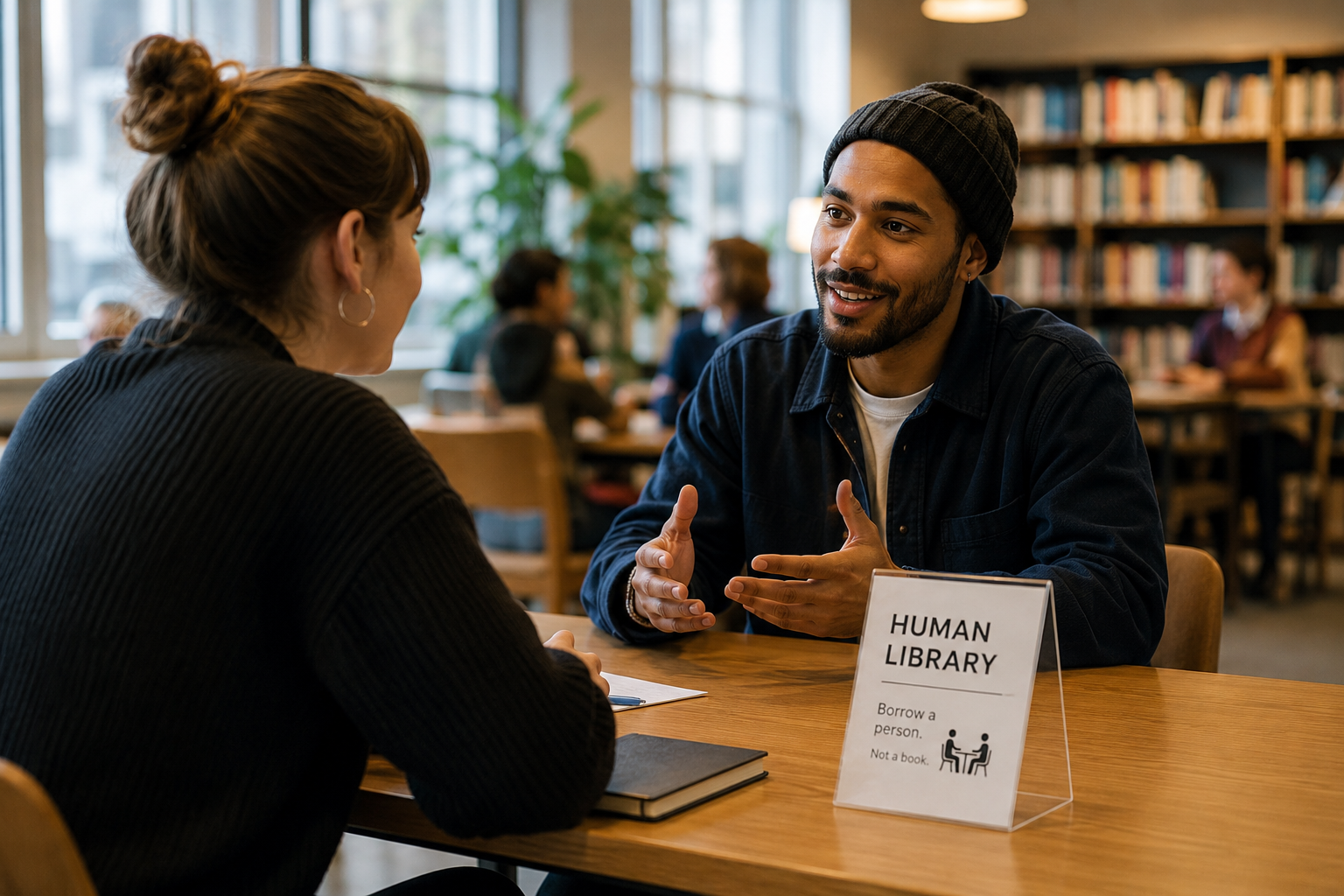
At these events, volunteers become Human Books, while visitors become Readers. Rather than turning pages, Readers take part in open conversations with people whose experiences are often misunderstood, stereotyped, or judged.
How the Human Library Began
The Human Library was developed in Copenhagen, Denmark, in 2000.
Its original Danish name was Menneskebiblioteket, and the concept was first presented as a project at the Roskilde Festival.
The goal was simple: create a safe setting where people who might never normally speak to one another could meet and have honest conversations.
What Is a Human Book?
A Human Book is a volunteer willing to discuss personal experiences connected to prejudice, stigma, or misunderstanding.
A Book might speak about living with a disability, experiencing homelessness, belonging to a religious minority, recovering from addiction, working in a profession that attracts judgment, or navigating another identity that people often misunderstand.
Readers are encouraged to ask sincere and respectful questions.
The conversation gives them an opportunity to learn directly from a person rather than relying on assumptions, headlines, or stereotypes.
A Conversation Instead of a Lecture
The Human Library does not function like a traditional presentation.
Each interaction is a conversation.
Readers can ask questions that may feel difficult to raise elsewhere, while Books decide how much of their experience they are comfortable sharing.
The organization is designed to create a respectful space where sensitive subjects can be discussed openly and without condemnation.
Challenging the Way We Judge Others
People often form opinions before knowing someone's story.
The Human Library challenges that habit by bringing people together face to face.
A single conversation may not erase every prejudice, but it can replace an abstract label with a real person, a real voice, and a real experience.
A Global Idea
What began as a Danish festival project has grown into an international movement.
Human Library events have been organized in schools, universities, workplaces, libraries, festivals, and community spaces around the world.
Its message remains simple:
Do not judge a book by its cover, especially when the “book” is a human being.