
Full Story
Jimothy: The Unusually Shaped Raccoon That Confused the Internet
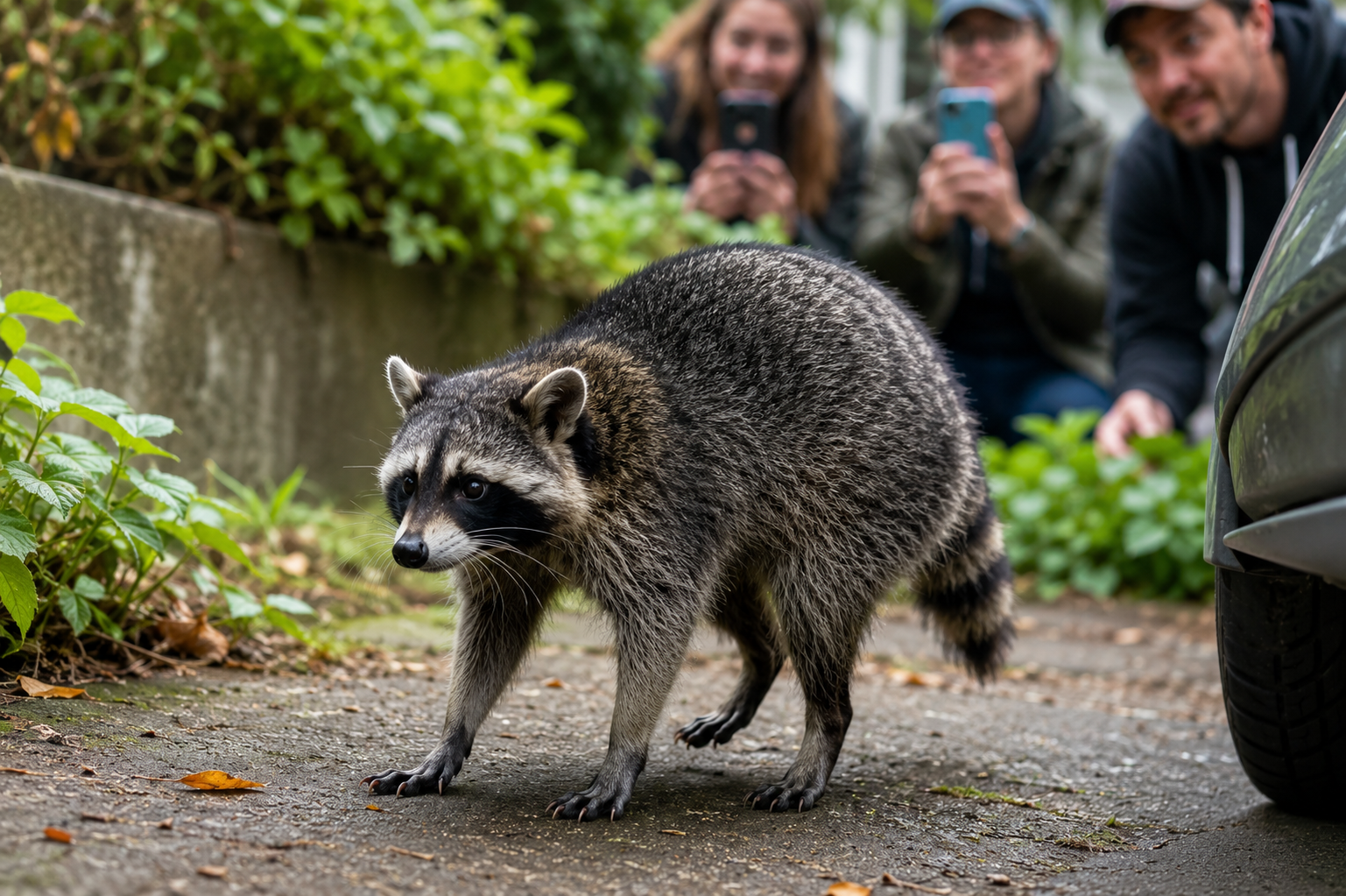
In July 2026, Seattle resident Kiana Hall noticed a small animal moving beneath a parked car in the city’s Ballard neighborhood.
At first, she thought it might be a cat.
Then it stepped into view.
The animal had long legs, a very short body, a rounded back, and almost no visible neck. Its proportions looked so unfamiliar that Hall could not immediately determine what she was seeing.
Once it turned around, its dark facial mask revealed the answer.
It was a raccoon.
Hall recorded the animal and affectionately named it Jimothy. The short video quickly spread across social media and attracted millions of views.
Why Does Jimothy Look So Different?
Wildlife experts who examined the available videos believe Jimothy may have a rare condition known as short spine syndrome.
This congenital abnormality affects the development of the vertebrae before birth. Some vertebrae may fail to form normally, become compressed, or fuse together, creating a spine that is much shorter than expected.
Animals with the condition may have:
◎ A shortened back
◎ A curved or hunched posture
◎ A very short neck
◎ An unusually small tail
◎ Legs that appear disproportionately long
These features closely resemble Jimothy’s appearance.
However, Jimothy has not been captured or medically examined. Experts therefore cannot confirm his condition with certainty.
What Causes Short Spine Syndrome?
Short spine syndrome is believed to have a genetic origin.
During normal development, the spine forms as individual vertebrae separate and harden into bone. In animals with the syndrome, this process does not occur correctly. The vertebrae may remain compressed or become fused, producing the animal’s distinctive compact shape.
The condition is extremely rare, particularly in wild animals. Individuals born with serious skeletal abnormalities may struggle to survive infancy, which could explain why so few cases are ever observed.
Is Jimothy in Pain?
No one can determine Jimothy’s health from videos alone.
Some animals with short spine syndrome can experience joint strain, restricted movement, or spinal discomfort. Others appear to live active and relatively normal lives.
Jimothy’s behavior provides encouraging signs.
Videos show him:
◎ Walking independently
◎ Climbing stairs and fences
◎ Foraging for food
◎ Moving through residential areas
◎ Reacting normally to his surroundings
Wildlife experts have noted that an animal with a severely disabling condition would probably have struggled to survive this long in the wild.
Built for Survival
Raccoons are exceptionally adaptable animals.
They can eat a wide variety of foods, climb effectively, use their paws to manipulate objects, and create dens in trees, buildings, and other protected spaces.
These abilities may help Jimothy compensate for his unusual body structure.
His survival does not prove that the condition causes no difficulties, but it demonstrates that he has successfully adapted to his environment.
Should People Try to Help Him?
Wildlife specialists recommend leaving Jimothy alone unless he shows clear signs of injury, illness, or immediate danger.
Approaching, feeding, chasing, or attempting to capture a wild raccoon can create unnecessary stress. It can also encourage the animal to associate people with food, increasing the risk of conflict.
The best way to support Jimothy is to observe him respectfully from a distance and allow him to continue living as a wild animal.
An Unexpected Internet Star
Jimothy became popular because his appearance was surprising, but his story represents something more meaningful.
Despite a body that developed differently, he appears to be navigating the same world as every other raccoon.
He walks.
He climbs.
He searches for food.
And when the internet finally figured out what he was, millions of people began cheering him on.