
Full Story
What Would Really Happen If You Fell Into a Black Hole?
Black holes have fascinated scientists and science-fiction fans for decades.
They are regions of space where gravity becomes so powerful that nothing—not even light—can escape once it passes a boundary called the event horizon.
But what would actually happen if you fell into one?
The Journey Begins
If you approached a black hole from a safe distance, you might not notice anything unusual at first.
However, as you moved closer, gravity would become dramatically stronger.
The side of your body closest to the black hole would experience a much stronger gravitational pull than the side farther away.
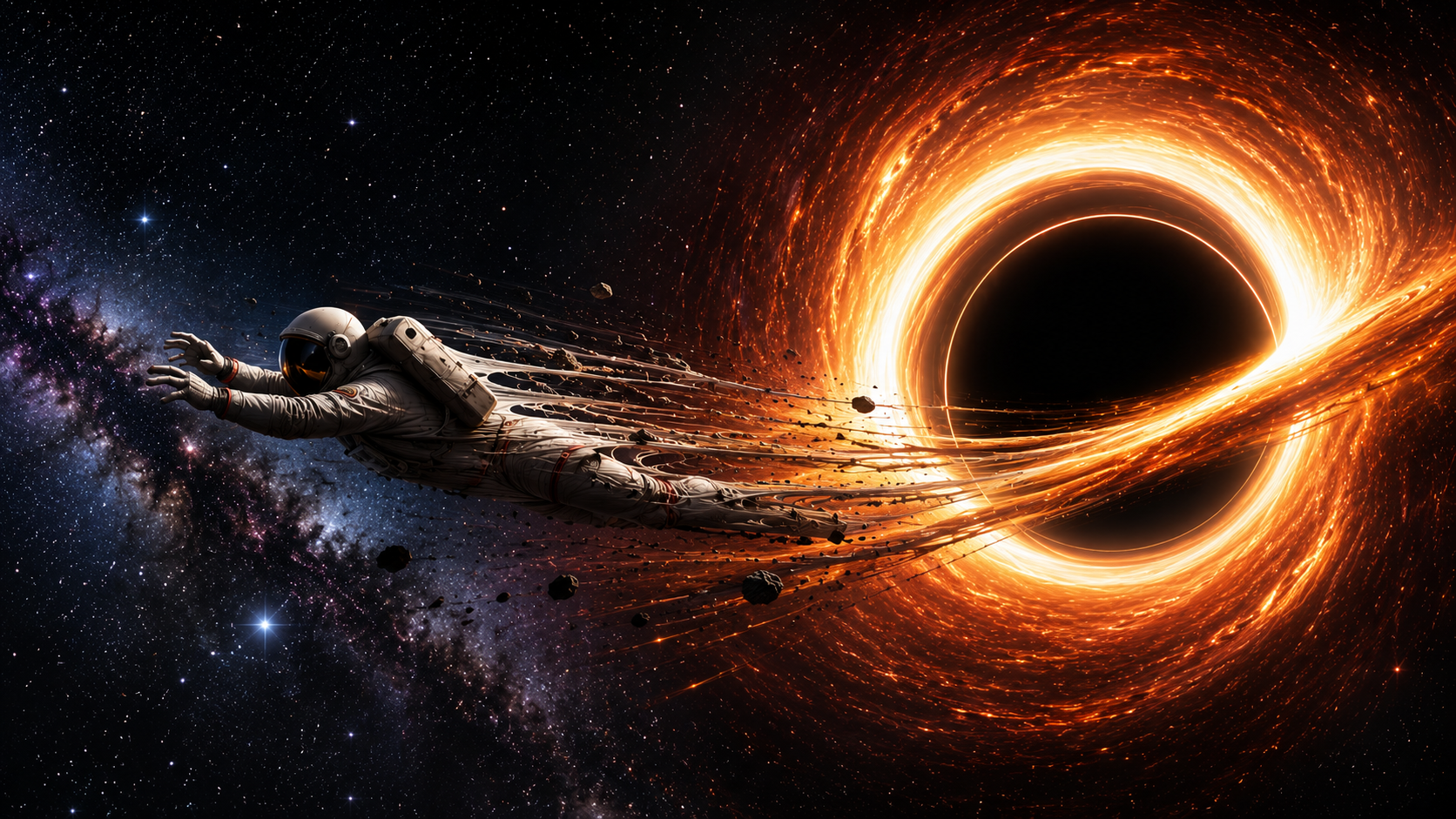
Spaghettification
Scientists call this extreme stretching effect spaghettification.
The enormous difference in gravity between your head and your feet would gradually stretch your body into a long, thin shape while compressing it sideways.
Near smaller black holes, this would likely happen before you ever reached the event horizon.
For supermassive black holes, however, you could potentially cross the event horizon before the stretching became deadly.
Crossing the Event Horizon
Surprisingly, crossing the event horizon might not feel like crossing a physical barrier.
From your own perspective, you could pass it without noticing anything special.
However, an outside observer would never actually see you cross it.
Because of extreme gravitational time dilation, you would appear to slow down and fade from view.
What Happens Next?
This is where science reaches its limits.
Current theories disagree about what happens inside a black hole.
Some suggest everything eventually collapses into an incredibly dense singularity.
Others propose entirely different possibilities involving quantum physics.
At present, nobody knows for certain.
Nature's Greatest Mystery
Black holes continue to challenge our understanding of gravity, space, and time.
Studying them may eventually help scientists unite Einstein's theory of general relativity with quantum mechanics—one of the greatest unsolved problems in physics.
For now, what lies beyond the event horizon remains one of the biggest mysteries in the universe.