
Full Story
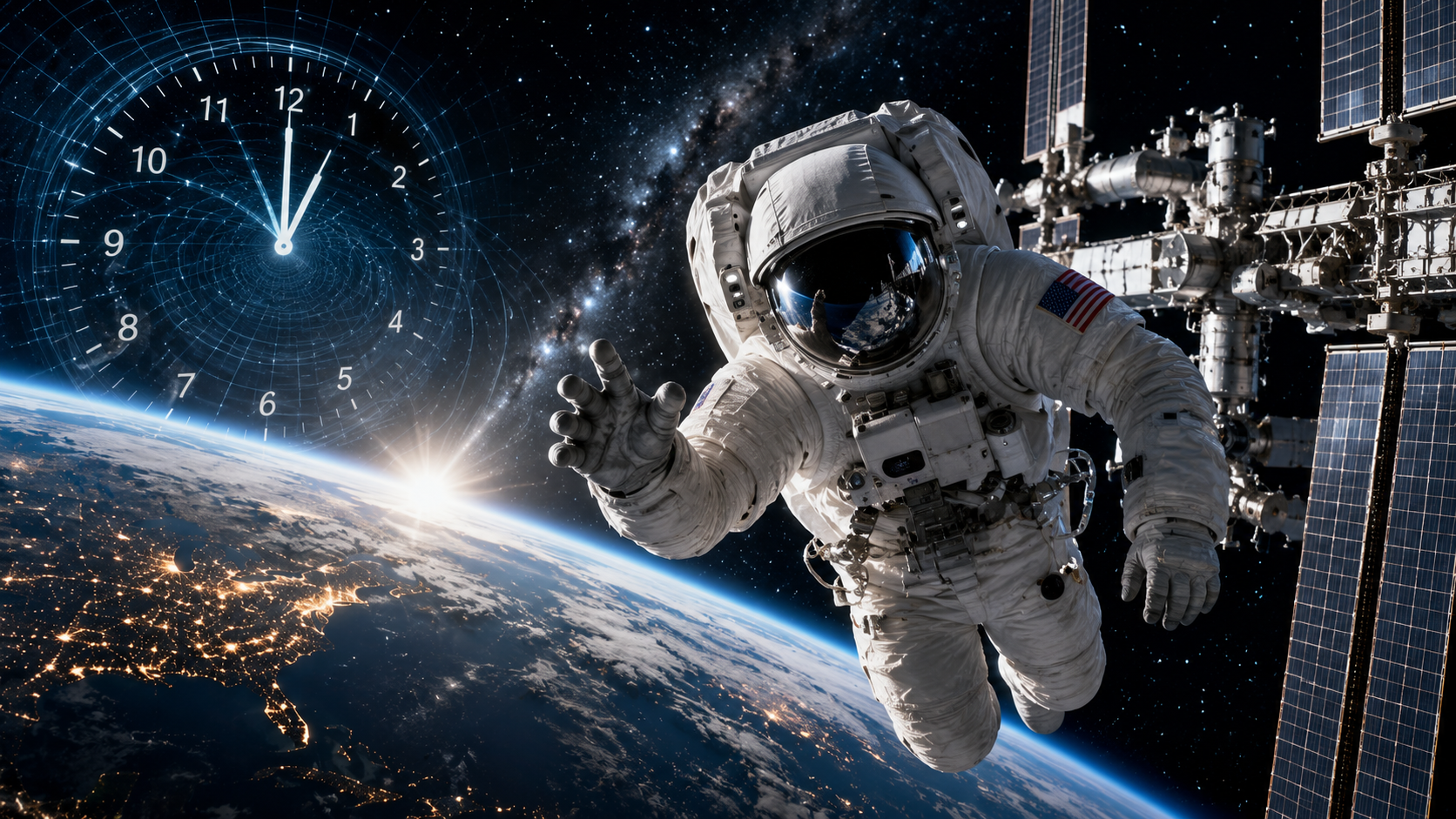
Astronauts Are Actually Time Travelers
Could someone really travel into the future?
Surprisingly...
the answer is yes.
Einstein's Incredible Discovery
In 1905, Albert Einstein published his Special Theory of Relativity.
One of its most surprising predictions was that time itself can slow down.
The faster something moves, the more slowly time passes for it compared with someone moving more slowly.
This effect is called time dilation.
Astronauts Experience It
Astronauts aboard spacecraft travel at incredible speeds.
For example, astronauts on the International Space Station (ISS) orbit Earth at roughly 28,000 kilometers (17,500 miles) per hour.
Because of that tremendous speed, time passes just a tiny bit more slowly for them than it does for people on Earth.
When they return home, they are micoseconds younger than they otherwise would have been.
Gravity Also Matters
Einstein later expanded this idea with General Relativity.
Gravity also changes how quickly time passes.
Being farther from Earth's gravity causes clocks to tick slightly faster, while high speed causes them to tick slightly slower.
For astronauts in low Earth orbit, these two effects partially offset one another, but the speed effect is slightly stronger.
Proven by Science
Time dilation isn't just a theory.
Scientists have measured it using incredibly precise atomic clocks carried aboard aircraft, satellites, and spacecraft.
Even the GPS satellites guiding your smartphone must account for relativity every single day.
Without those corrections, GPS locations would drift by several kilometers each day.
Tiny Time Travelers
Astronauts won't leap centuries into the future like in science fiction.
But they do return having experienced slightly less time than everyone who stayed on Earth.
It may only be a fraction of a second...
but according to Einstein,
they really are time travelers.